
An investigation undertaken by the Ombudsman led to NEMA releasing documents that show animals were the biggest issue the Emergency Management Bill but…
In our last update on the NoAnimalLeftBehind campaign, we promised we would maintain pressure on government to go beyond mandating plans for animal disaster management by civil defence emergency management groups as this was just a third of what the US passed in 2006 with their Pet Emergency & Transportation Standards Act. We made an Official Information Act request for the analysis of public submissions and this was refused by NEMA. This led to a complaint to the Ombudsman who opened an official investigation into the refusal, leading to a number of heavily redacted documents being released. These documents revealed that what has been proposed by officials doesn’t reflect what the public of New Zealand wanted in their submissions, undermining citizenry participation. Moreso, what is proposed is doctrine that is nearly 20 years old and needs more than just three parts (like the PETS Act 2006).
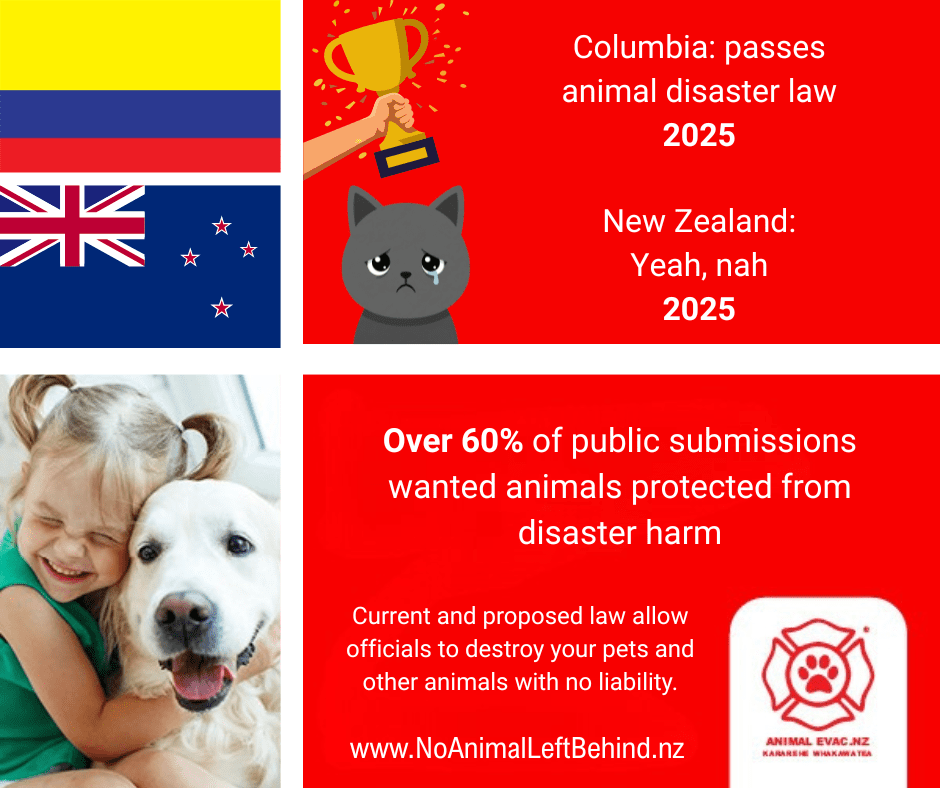
New Zealander’s may be surprised that Columbia now has better animal disaster protection laws than New Zealand. They recently passed Law 2474 of 2025, which amends the national disaster law (Law 1523 of 2012) with key changes and requirements relating to animals:
– Animals are explicitly recognized as recipients of attention and prevention measures within disaster risk management policies.
– Disaster risk management processes must contribute to the protection and care of animals alongside human safety, ensuring animal welfare in disaster situations.
– A principle of solidarity with animals is introduced, mandating support for preventive and protective actions for animals affected by emergencies.
– The precautionary principle requires authorities to act to prevent potential harm to animal lives, even without absolute scientific certainty.
– Specific protocols for the rescue, assessment, and care of animals during disasters are mandated, including emergency veterinary care, safe transportation, and temporary housing.
– The government is tasked with implementing training and educational campaigns focused on animal rescue and welfare during disasters for emergency responders, volunteers, and the public.
– The national government will provide support and incentives for entities offering temporary shelters, veterinary care, or food supply services for animals during disasters.
– Animal-related information must be included in the National Information System for Disaster Risk Management to ensure their needs are accounted for in disaster planning and response.
– Territorial entities are required to adjust their disaster risk management strategies to align with the new animal protection guidelines established in the law.
These changes reflect a significant shift in the approach to animal welfare in the context of disaster management, emphasising their protection and care. Yet New Zealand, an apparent world leader in emergency management and animal welfare, can only chalk up just one of these requirements.
Our 2019 report presented at Parliament was supported by the former head of the US Federal Emergency Management Agency, Craig W. Fugate. Mr Fugate is undoubtedbly one of the world’s leading authorities in emergency management having been appointed by US President Barrack Obama to administer FEMA and having led the US federal government through more than 500 major disasters and emergencies. No one in New Zealand has this level of experience. In his guest presentation, he applauded our report and the need for New Zealand to improve it’s disaster laws by including animals.
Though there are some significant questions around genuine public participation in the consultation process, and concerns around transparency and accountability, our focus is supporting the Governance and Administration Select Committee (GAC) with empirical advice based on published studies – not opinion or agendas. We as Kiwi’s have a once in a lifetime opportunity to lead the world, developing gold standard emergency management law that protects animals from disaster harm. Congratulations to the Government of Columbia! Can we do better than Columbia for our animals? It would be un-kiwi not to.
Nga mihi nui
Dr Steve Glassey
Patron
Please donate at www.animalevac.nz/donate
We just recieved the new Emergency Management Bill as it was introduced to parliament today.
It is available from the New Zealand Legislation website.
Though there is a solid win with animals to be specifically planned for at the regional level under clause 91, from a cursory reading there are significant gaps that need attention.
We will a more detailed post once we have analysed the new bill. And yes, for a small charity with zero staff and less than $1000 in our bank account we are still relentlesss to be at the forefront to protect animals from disaster harm in New Zealand!